
Receptors, nutrients, synaptic vesicles — and more than a few viruses — enter the cell through clathrin-mediated endocytosis, and that pathway runs through the AP2 adaptor complex. Its alpha subunit, AP2A1, sits at the coat's core. An AP2A1 antagonist would be a molecular handbrake on cellular import. No such molecule exists in the clinic. This site explains the target, the tools that miss it, and the design programme aiming at it.
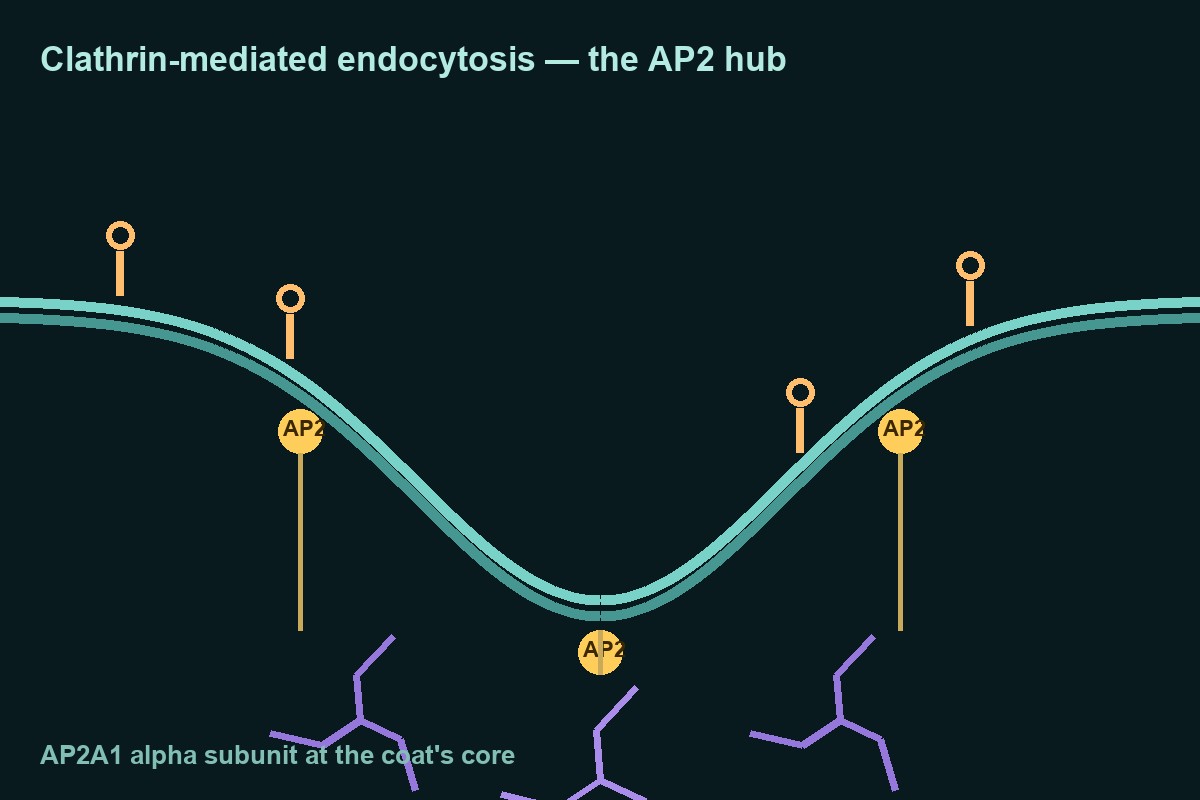
Clathrin-mediated endocytosis is the cell's main import route. It begins when the AP2 complex — a heterotetramer of alpha (AP2A1), beta2, mu2 and sigma2 subunits — docks onto the plasma membrane, binds its lipid signature (PIP2), grabs cargo motifs on receptors, and recruits clathrin triskelions that curve the membrane into a coated pit, then a vesicle. The 2002 structure from Collins, Owen and colleagues at the MRC Laboratory of Molecular Biology in Cambridge showed AP2 as the coat's organising hub: remove the hub and the coat has nothing to build on.
Vesicular stomatitis virus, dengue, hepatitis C and — in part — influenza all enter cells through clathrin-mediated endocytosis (reviewed by Mercer, Schelhaas & Helenius, 2010). A hub blocker is, in principle, a broad-spectrum door closer — with the enormous caveat that the same door serves the host.
Growth-factor receptors such as EGFR are pulled into the cell through AP2 and clathrin (reviewed by Goh & Sorkin, 2013). Signalling strength is set as much by how fast receptors are removed as by how strongly they fire — an antagonist would rewrite that arithmetic.
Every fired synapse retrieves its spent vesicles through clathrin-mediated endocytosis (reviewed by Saheki & De Camilli, 2012). Neurons run this pathway harder than any other cell type — a hub blocker would be felt in the brain first.
In 2025, Chantachotikul and colleagues in Shinji Deguchi's lab at the University of Osaka reported that AP2A1 accumulates along stress fibres of senescent cells — and that knocking AP2A1 down reversed senescence phenotypes, while overexpressing it pushed young cells toward senescence. A switch between aged and rejuvenated states, wired through an endocytosis protein nobody expected.
Search the pharmacopoeia for an AP2A1 antagonist and you find nothing. The pathway has tool compounds; the hub does not.
One neutral scoreboard exists. The US National Institutes of Health's Illuminating the Druggable Genome programme assigns every human protein a target-development level in its Pharos database, and AP2A1 is classified Tbio: the tier for proteins with a substantial body of published biology but no drug and no small-molecule chemical probe aimed at them. Above the uncharted “dark” tier, below every target that chemistry has actually reached. The toolbox history above and the NIH classification arrive at the same answer from opposite directions — the hub is known, and it is untouched.
For the biology underneath this programme — the gene, the protein, the senescence link and the disease literature around AP2A1 — see the sister page ap2a1.com, which covers that layer in depth; this site stays on the antagonist-design question.
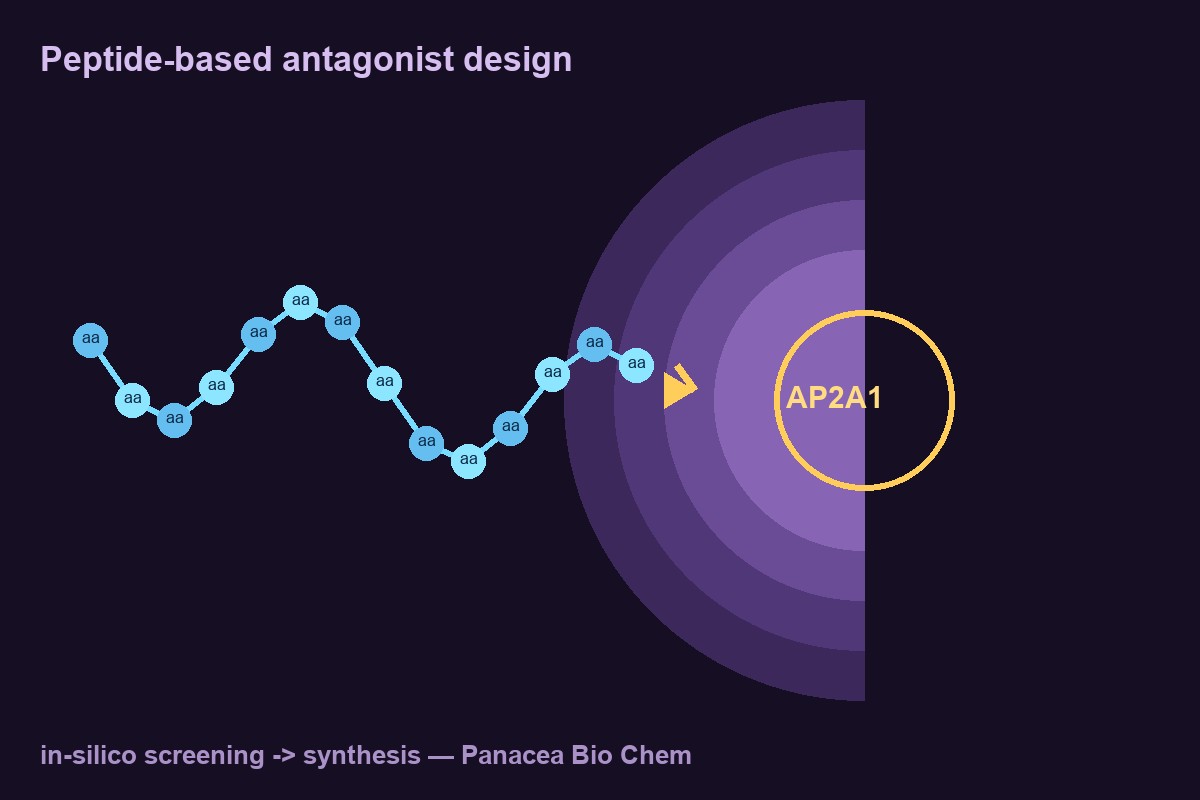
Small molecules struggle at large, flat protein-protein interfaces — and AP2's business end is nothing but interfaces. Panacea Bio Chem's programme, led by Bogdan Dicoias, takes the route the geometry suggests: peptide-based AP2A1 antagonists. In-silico screening of designer amino acid chain (AAC) candidates against the AP2 alpha hub — its membrane-docking and clathrin-recruiting surfaces — followed by synthesis of the leading designs and bench characterization. Peptides can carpet an interface a small molecule cannot grip, and they can be tuned residue by residue.
The boundary, stated plainly: this is a design programme. Panacea claims no binding data, no cellular results, and no senescence experiments of its own — none are fabricated here, and the candidate library, sequences and screening architecture remain Panacea intellectual property pending peer-reviewed disclosure.
In-silico screening + synthesis direction · no fabricated results
"Everyone who wants to stop endocytosis reaches for dynamin or clathrin — the engine and the bricks. We are interested in the blueprint reader. AP2 decides what gets imported and when; a peptide that sits on its alpha hub does not smash the machine, it takes the pen out of its hand. That is a design problem, and design problems are what amino acid chains are for."
Bogdan Dicoias — Biochemist · AAC Designer · Panacea Bio Chem Ltd
The alpha-1 subunit of the AP2 adaptor complex — the hub of clathrin-mediated endocytosis, the cell's main import route for receptors, vesicles and several viruses.
No. Dynasore hits dynamin; the Pitstops hit clathrin (and more); no approved or clinical-stage AP2A1-specific antagonist exists. The target is open frontier — more on the Questions page.
A 2025 University of Osaka study found AP2A1 elevated in senescent cells — and that knocking it down reversed senescence phenotypes. Knockdown, not a drug: the pharmacological version does not exist yet.
Peptide-based AP2A1 antagonists — in-silico screening of designer AAC candidates against the AP2 alpha hub, then synthesis. The full credited science is on The Research.
Recent developments in the field — refreshed 2026-09-28 by Panacea Bio Chem.
The Panacea Technology Universe
Proprietary Panacea Bio Chem Ltd technologies, invented by Bogdan Dicoias — what each one does, and why it leads its class.
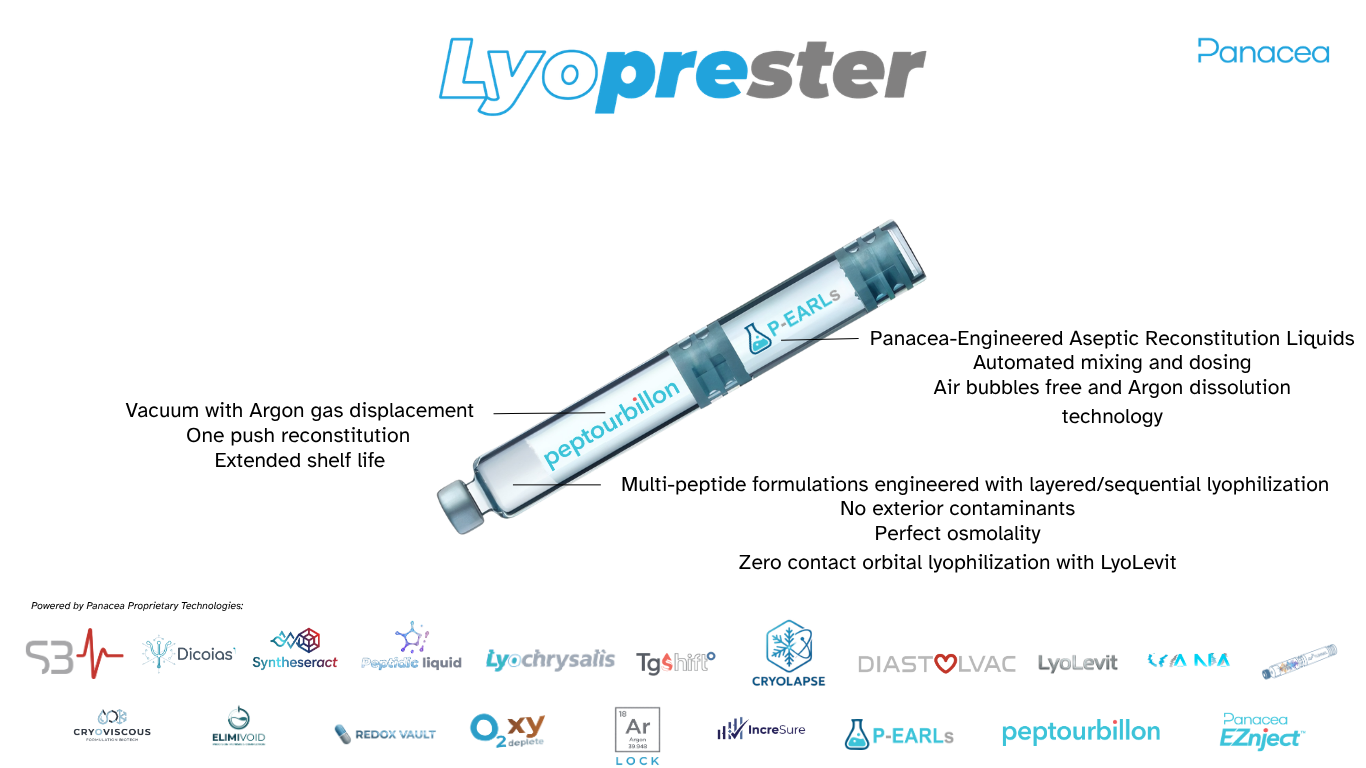
 Lyoprester®The only dual-chamber cartridge that is autoreconstitution-enabled, vacuum-sealed and argon-fillback.lyoprester.com ↗
 P-EARLs™Panacea-Engineered Aseptic Reconstitution Liquid(s) — each tuned to the peptide it wakes.p-earls.com ↗
 Peptourbillon™The layered peptide formulation architecture — single- or multi-layer, never a blend.peptourbillon.com ↗
 RF Tunnel™The RF-formed central channel through the cake.rftunnel.com ↗
 TgShift™Raises the cake’s glass-transition temperature with RF — instead of chilling below it.tgshift.com ↗
 Cryolapse™Cryogenic pressure collapse under S3Pulse™ control — vapour redistributed through the whole cake, not its surface, impeding crust formation.cryolapse.com ↗
 LyoLevit™The cake levitates and spins in high orbit — driven by ultrasound and RF.lyolevit.com ↗
 Lyochrysalis™The integrated chamber housing the whole drying stack.lyochrysalis.com ↗
 S3Pulse™The control brain for every piece of Panacea hardware.s3pulse.com ↗
 Liquiprester™The single-liquid cartridge engineered so multiple peptide APIs coexist in one shared vehicle.liquiprester.com ↗
 Syntheseract™Continuous-flow peptide synthesis in a special, very fast and economical way.syntheseract.com ↗
 CFSPPS™Continuous-flow solid-phase peptide synthesis, written as its own category.cfspps.com ↗
 OxyDeplete™Degassing plus no-headspace doctrine — the oxygen-starved seal.oxydeplete.com ↗
 ArgonLock™The final inert-atmosphere lock under argon.argonlock.com ↗
 RedoxVault™Separation, not merely suppression — redox isolation in lipid micro-reservoirs.redoxvault.com ↗
 PleniDose™The shared filling gantry — one machine filling both the dual-chamber Lyoprester and the liquid Liquiprester.plenidose.com ↗
 IncreSure™The dose-metrology layer — verified API per pen increment.incresure.com ↗
 ElimiVoid™Front-void elimination without touching the metered dose.elimivoid.com ↗
 Cryoviscous™The characterised cold, high-viscosity, low-mobility conditioning state.cryoviscous.com ↗
 Vana Machine™Vacuum Assisted Needle Accessory — vacuum conditioning and plunger-locking for the cartridge.www.vanamachine.com ↗
 EZnject™The disposable auto-injector pen built around the Lyoprester.panaceaeznject.com ↗
 Dicoias ΨThe computed-chemistry advisory — every substance reduced to a vector across physical, electronic and formulation space.dcppsi.com ↗
 SealoPrester™Aseptic Cartridge Closure System — Seal o’ Precision + Sterility.sealoprester.com ↗
 Peptidic LiquidThe peptide formulation in solution — the active plus its buffers, cryoprotectants, lyoprotectants and scaffolders.peptidicliquid.com ↗
 DiastolVAC™Biomimetic diastolic vacuum control — the pneumatic circulatory system of the machine: pumps, valves and sensors as one ensemble.diastolvac.com ↗
 KineticON™Motion Integrity Architecture — the motion-control layer that lets the machine know what happened on every axis move.kineticon.org ↗
No publication indexed in PubMed in the last 30 days for ("AP2A1"[tiab] OR "AP-2 adaptor complex"[tiab] OR "AP2 adaptor complex"[tiab] OR "adaptor protein complex 2"[tiab] OR "AP-2 complex"[tiab] OR "AP2 complex"[tiab] OR "clathrin adaptor AP-2"[tiab] OR "clathrin adaptor AP2"[tiab]) AND (endocytosis[tiab] OR clathrin[tiab] OR inhibitor*[tiab] OR antagonist*[tiab] OR senescence[tiab]) — the most recent in the field, refreshed weekly.